Technology-Powered Education
Teaching experience


MEDD8931 (2024 - now)
People-centric Design for Education Using Simulation Technology
As simulation technologies become increasingly accessible in educational settings, they offer the potential to bring the invisible to life, makes feelings, sensations and experiences that cannot be easily communicated verbally ot textually experienceable, bridge gaps in understanding, and enhance the teaching of STEM, art, humanities and communication. However, local cultural contexts and human interaction are often overlooked or even replaced, diminishing the promise of real-life impact. For educators and students alike, the challenge lies in emphasizing, reinforcing, as well as enhancing irreplaceable critical human skills in how we teach and how we apply technology. The human (teaching & learning - transfer of knowledge and its application) experience should be the purpose, while technology serves as the means.


MEDD8894 (2024 - now)
Design Thinking and Education
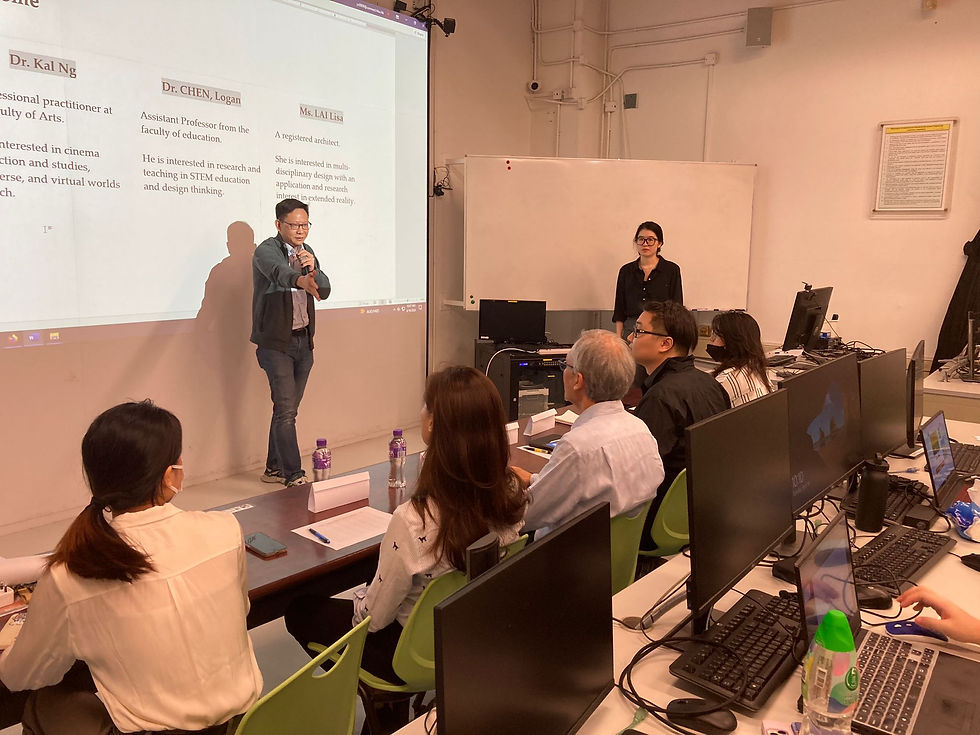
Designing has been practiced for ages in the world: pencil and paper, engines and headphones, metro systems and urban planning, artwork and social media, everyday things, and many other solution-centric end-products. Design is a humane way of engineering that approach fundamental issues by using transdisciplinary methodologies to understand and serve human, social, and environmental needs. Learning by design is a pedagogical approach that empowers students to bring their disciplinary knowledge, scientific methods, pro-social values, and creativity together in authentic and lifelong STEM Education. To make learning by design possible, a teacher needs to experience, embody, apply, and teach design thinking that comprises 6 interconnected phases: emphasizing, defining, ideating, prototyping, testing, and implementation. This course adopts the train-the-trainer model that 1) places learners (in service and future educators) in different design experiences and challenges to practice different skill sets, 2) supervises learners to synthesize and apply these skill sets in a real-life project, and 3) fosters learners to reflect and develop on their personal pedagogies.

IMSE 7137 (2023 - now)
Virtual Reality for Systems Engineering
This course is designed to understand the current applications and impact of virtual reality technology to society, and to describe typical virtual reality systems for practical deployment, to understand the technology, methods, and components of virtual reality, and to apply virtual reality technology to design simple solutions and systems, and construct working virtual reality-based systems.

CCHU 9056 (2023 - 2024)
Virtual Worlds, Real Bodies
By engaging students on an explorative journey of the emergence and development of VR in our modern societies, and giving them hands-on practice in creating their own virtual worlds, this course encourages students to reflect, evaluate and contemplate from multiple perspectives on how modern computer and digital technologies “inhabit” our bodies, and the world. Through realizing how our physical bodies have come to embody such technologies and making them an inseparable part of our everyday realities, we thereby expand the horizon of human experiences and meaning making. And ultimately, through grasping the notion of techno-embodiment, students are expected to raise and attempt to answer the philosophical and ethical questions of what technologies can and cannot do, and should and should not do in creating new human living experiences.


HKUSI ENGSC1010B (2023 - now)
Engineering Science in Response to Global Challenges
For mroe activies, please check the website of our students interest group:
And YouTube Channel: